
Pakistan censorship: 'Hovering above the mute button'
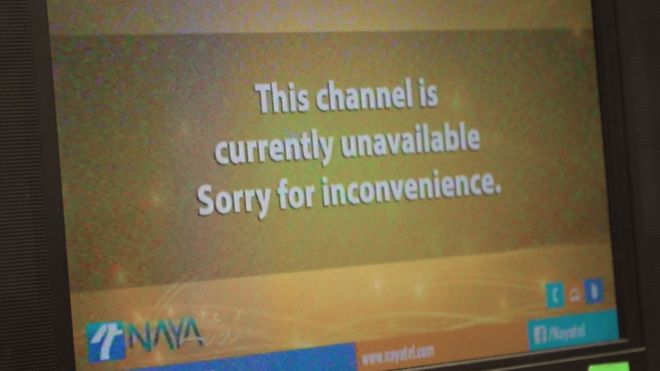
The interview, between one of Pakistan's best-known TV news anchors, Hamid Mir, and leading opposition politician Asif Ali Zardari, was only a few minutes into its transmission when it was suddenly interrupted by an unscheduled ad break and news bulletin.
Mr Mir vented his frustration on Twitter, blaming unnamed censors. "We are not living in a free country," he said.
Just over a week later, another TV interview, of another opposition politician, Maryam Nawaz Sharif, cut to an unexpected ad break midway. When the break ended, instead of Ms Sharif, viewers were presented with an old interview of a leading figure from the ruling party.
The journalist conducting the interview, however, continued with his questions, broadcasting instead online via a video streaming app.
These are two of the most prominent examples of what has been termed "unannounced censorship" in Pakistan. Last week journalists held protests outside press clubs in major cities across the country demanding an end to restrictions on what they publish and broadcast.
Supporters of the government claim the complaints are made by biased journalists. During a visit to Washington this week Prime Minister Imran Khan dismissed allegations of censorship, telling reporters: "To say there are curbs on [the] Pakistani press is a joke."
However, there appears to be clear evidence of attempts to prevent criticism of Mr Khan's government and the Pakistani military, as well as to suppress claims by his political opponents that they are being unfairly accused in corruption cases.Pakistan is ranked 142nd out of 180 countries in the 2019 Reporters Without Borders Press Freedom Index.
The Pakistani Army denies having any role in media censorship.
- Where reporters face beatings, threats and death
- Pakistan reporter flees armed abductors
- Uncovering Pakistan's secret human rights abuses
The clampdown on press freedom inside the country contrasts with attempts by the Pakistani authorities to improve their foreign relations, notably with the US, Afghanistan and India. President Trump has praised Pakistan for its role in facilitating peace talks with the Taliban.
One of the main targets of the current censorship blitz is Maryam Nawaz Sharif, whose father, former Prime Minister Nawaz Sharif, is serving a jail sentence on corruption charges.
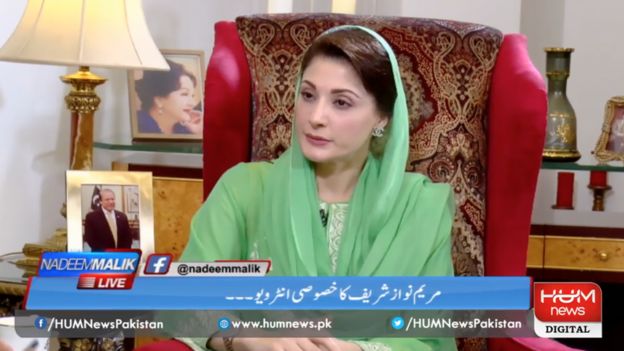 HUM TV
Earlier this month Ms Sharif released a secretly recorded video of one of the judges who had convicted her father, apparently admitting he had been blackmailed into finding him guilty. The judge subsequently denied the claims, saying the video had been "edited", but a number of channels who broadcast Ms Sharif's news conference were later taken off air for several days. At other times, parts of speeches from Ms Sharif's rallies broadcast on television have been muted.
One journalist, who asked to remain anonymous for his own safety, told the BBC how censorship worked. He explained that TV channels broadcast live programmes with a delay of at least about 10 seconds, with "an employee hovering over the mute button".
He said topics that would require muting - or if a whole segment was too controversial, a quick cut to adverts - included criticism of the government or Pakistan's powerful security establishment, which is supportive of Imran Khan's administration.
Failure to comply, the journalist told me, would result in angry phone calls or visits from members of the Pakistani army or intelligence services. Instead of threats directed at media workers, pressure tactics would be applied to the channel itself. "Advertising agencies get told, 'Don't them give ads.' Cable operators get told to change the number the channel appears on, or just to shut them down completely," he said. "They've got their hands around our throats."
However, it would be wrong to suggest there's a complete blackout on all political criticism on the airwaves. Prime Minister Imran Khan has claimed he has faced "unprecedented" personal attacks in the press. Meanwhile opposition politicians, other than Maryam Nawaz Sharif, do still regularly appear on talk shows.
"We are a democracy on paper… you can't do an Egypt here by imposing a blanket ban," said media analyst Adnan Rehmat.
Censorship in Pakistan, he said, was aimed at restricting interviews of "the top leadership" of opposition parties and coverage of their rallies. But "second- or third-tier" figures were allowed to take part in TV programmes as they are "not newsmakers". The application of censorship varies in intensity, Mr Rehmat added. Sometimes it is "heavy-handed" and at times more subtle.

Comments
Post a Comment